
Are You on the Ferry or the Yacht in CNC Manufacturing?
Whether you’re a CNC machine shop owner, a CAM programmer, or a machinist on the shop floor, there’s an uncomfortable reality in modern CNC manufacturing.
Most companies are moving in exactly the same direction.
They use similar CAM strategies. They rely on similar toolpaths. They often run the same cutting tools and follow nearly identical workflows.
In many ways, the industry is crowded onto the same ferry — traveling the same route, at the same pace, dealing with the same inefficiencies.
For many manufacturers, this approach feels safe. After all, the ferry eventually gets everyone to the destination.
But there’s a problem with that mindset.
If everyone is on the same boat, everyone arrives at the same place — no sooner and no better.
And in a competitive manufacturing environment, that’s not enough.
Getting Off the Ferry
The companies that truly stand out are the ones that choose a different route.
Instead of staying on the crowded ferry, they step off and find their own yacht — a faster, more agile path that gives them full control over their journey.
A yacht doesn’t just follow the route. It allows you to optimize the entire trip.
In CNC machining, that means looking beyond default CAM outputs and taking control of the actual NC program that drives the machine.
Because the truth is simple: The CNC machine does not run toolpaths. It runs G-code.
Why G-code Matters More Than You Think
CAM software is an essential part of modern manufacturing, but it often focuses on generating toolpaths rather than optimizing the final NC program.
The result is G-code that frequently contains:
Unnecessary air cuts that add nothing but time
Inefficient retracts and repositioning movements
Conservative feedrates that ignore real cutting conditions
Generic post-processing that isn’t fully optimized for the machine
Individually, these inefficiencies may seem small.
But over hundreds or thousands of production cycles, they become silent productivity killers — increasing cycle times, wasting machine capacity, and quietly reducing profitability.
This is where a smarter approach becomes critical.
Verifying the Reality, Not the Assumption
Many manufacturers rely solely on CAM simulations to validate their programs.
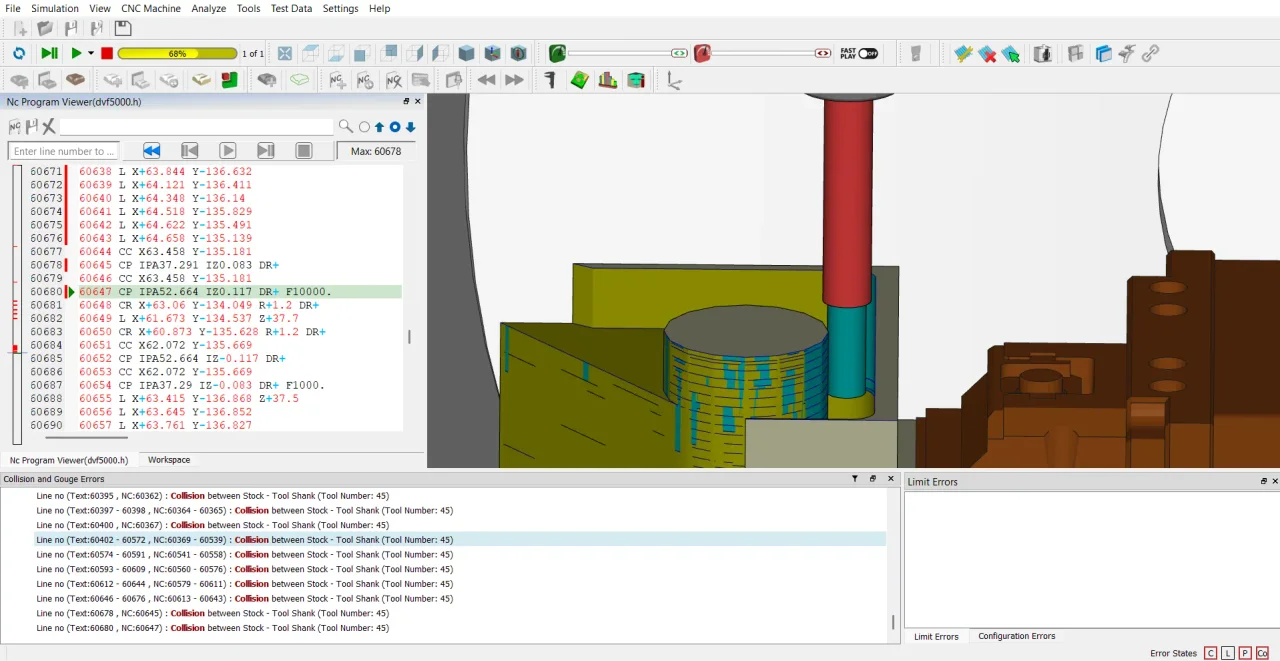
However, CAM simulations typically visualize toolpaths before post-processing, not the final G-code that the CNC machine actually executes.
That means certain issues can remain invisible until the program reaches the machine.
A more reliable approach is to analyze and verify the real G-code itself.
By working directly with the NC program, manufacturers gain a far more accurate understanding of machine behavior — allowing them to detect inefficiencies, identify potential issues, and refine motion at the level that truly matters.
From Verification to Optimization
Once the real G-code is visible and analyzable, optimization becomes possible.
Instead of accepting the program exactly as it comes from CAM, manufacturers can begin improving it:
Eliminating unnecessary air moves
Reducing inefficient repositioning movements
Optimizing feedrates based on actual cutting conditions
Shortening cycle times without compromising safety
This approach transforms the NC program from a static output into something that can be continuously improved.
And those improvements add up.
Shorter cycle times. Higher machine utilization. Lower production costs.
Choosing the Yacht
In manufacturing, real competitive advantage rarely comes from simply buying the same machines or using the same tools as everyone else.
It comes from using them more intelligently.
G-code optimization represents a shift in mindset — from passively accepting default outputs to actively refining the performance of every CNC program.
Solutions like MANUSsim and MANUSsimOptimize are built around this philosophy.
By verifying the real G-code and optimizing the motions within it, manufacturers gain the ability to eliminate hidden inefficiencies and unlock the full potential of their machines.
Because in the end, the difference in CNC manufacturing isn’t between companies that use machines and those that don’t.
The real difference is between those who stay on the ferry — and those who choose the yacht.
And the yacht always gets there faster.
Ready to see real G-code (NC Program) simulation in action?
Book a personalized demo of MANUSsim for your specific machines.